
198-Grasshopper (Melanoplus spp. & Camnula sp.)
Fact Sheet No. 198, UMaine Extension No. 2368
Prepared by Judith A. Collins, Assistant Scientist, and H. Y. Forsythe, Jr., Professor of Entomology, in cooperation with David Yarborough, Extension Blueberry Specialist, The University of Maine, Orono, ME 04469. November 1995.
Description
The hind legs are large and adapted for jumping. They vary in color from greenish-yellow to gray to brown to brownish-black (Photo 1). All vary in size up to 1 1/4-inches long when fully grown. Immature grasshoppers are smaller and closely resemble adults but do not have wings (Photo 2).
Life Cycle
Most grasshoppers spend the winter in the egg stage in the soil. The time for egg-laying varies with the species of grasshopper, but normally it begins after the middle of July and may continue through September for some species. Eggs are placed well below the surface of the ground, preferably in the firm, unbroken soil along roadsides, edges of fields, or in open areas of managed fields. Eggs begin to hatch in early to late May and the young grasshoppers, called nymphs, push to the surface of the ground and begin feeding on the nearest vegetation. The grasshoppers begin to become adults in early to late June and continue to feed on foliage and berries.

-
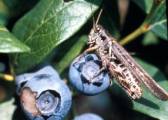
- Photo 1: Adult
-
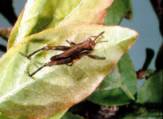
- Photo 2: Nymph
-

- Photo 3: Damage
Damage and Economic Importance
Several species of grasshoppers have been observed feeding on blueberries in Maine. The extent of damage varies from year to year depending on the species of grasshopper, numbers present, and weather. Both young grasshoppers and adults feed by chewing foliage and by biting and chewing on berries. Feeding damage is often detected later as a calloused scar on the fruit (Photo 3).
Pest Management
For information regarding monitoring and control, contact the lowbush blueberry specialist, University of Maine Cooperative Extension, 1.800.897.0757 (toll-free in Maine) or 207.581.2923.
Information in this publication is provided purely for educational purposes. No responsibility is assumed for any problems associated with the use of products or services mentioned. No endorsement of products or companies is intended, nor is criticism of unnamed products or companies implied.
© 1995
Call 800.287.0274 (in Maine), or 207.581.3188, for information on publications and program offerings from University of Maine Cooperative Extension, or visit extension.umaine.edu.
The University of Maine is an EEO/AA employer, and does not discriminate on the grounds of race, color, religion, sex, sexual orientation, transgender status, gender expression, national origin, citizenship status, age, disability, genetic information or veteran’s status in employment, education, and all other programs and activities. The following person has been designated to handle inquiries regarding non-discrimination policies: Director of Equal Opportunity, 101 Boudreau Hall, University of Maine, Orono, ME 04469-5754, 207.581.1226, TTY 711 (Maine Relay System).