
202-Blueberry Thrips
Fact Sheet No. 202, UMaine Extension No. 2373
Prepared by Francis A. Drummond, Professor of Entomology and Judith A. Collins, Assistant Scientist, and in cooperation with David Yarborough, Extension Blueberry Specialist, The University of Maine, Orono, ME 04469. Revised December 2012
Description
Thrips are very small (1/8 to 1/4-inch long) and difficult to see. Uncurling the rolled up leaves of actively infested plants will reveal small, slender, lemon-yellow thrips (Photo 1). This problem is more readily identified by the presence of very tightly rolled-together leaves and twisted stems on blueberry plants beginning early in the season (late May or early June) (Photo 2). Also, infested leaves often turn bright red and are quite conspicuous (Photo 3). Another pest, the blueberry tip midge (Dasineura oxycoccana (Johnson)), also causes rolled leaf galls. However, the leaf galls caused by the blueberry tip midge are loosely curled and more “football” shaped compared to the tighter and more slender “cigar” shaped galls caused by thrips. In addition, the galls caused by the blueberry tip midge are only at the terminal end of the stem and are usually green and dimpled; whereas, the galls caused by the blueberry thrips can envelop the entire stem and are smooth and are often red. Two species of thrips, Frankliniella vaccinii Morgan and Catinathrips kainos O’Neill, attack wild blueberries. There are slight differences in the phenology or seasonality of their life cycle, but in general, their biology is the same and the damage that they cause is identical.
Life Cycle
Blueberry thrips winter in the soil as adults. They overwinter in soil depths deep enough so that burning does not appear to affect their survival. Thrips emerge and feed on tender new plant material in late May to early June. Eggs are laid in developing leaf veins, and in the spring young, immature insects can be found within the curled leaves (curling results as a response to the damaged veins from egg laying). During the growing season, thrips develop through two larval stages that actively feed and then metamorphose into a non-feeding prepupal stage and a subsequent non-feeding pupal stage. New adults are found within the leaf galls in late July or early August. Typically in late summer, mature adult females (and some males), leave the plant and move back into the soil.

-
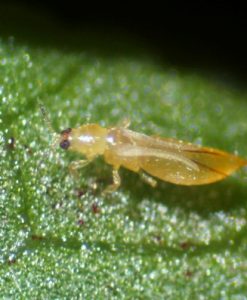
- Photo 1: Nymphs

-
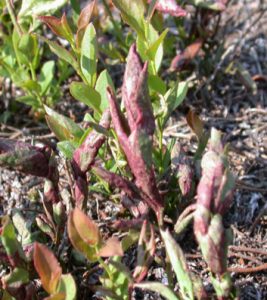
- Photo 2: Damage

-
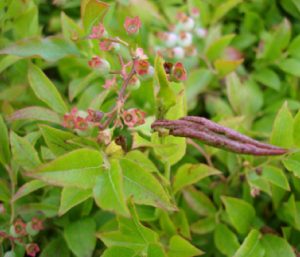
- Photo 3: Damage in Crop Year
Damage and Economic Importance
Thrips damaged plants can be found in both vegetative and fruit-bearing fields. However, it is harder to detect thrips infestations in fruit-bearing fields since the foliage can obscure the leaf galls. Greater densities of galls are found in vegetative fields possibly because more young and tender foliage is available for attack during the time when adult female thrips emerge from the soil. Economically important damage occurs in vegetative fields. Leaves infested with feeding thrips curl around the stem starting at the stem tip and then, as successive leaves emerge and are attacked, leaves curl around the stem from the top to the base of the stem. The infested leaves remain tightly curled around the stem of the plant throughout the growing season and shield the developing flower-bud tissue from the light so that flower buds do not develop. Heavily infested stems will have no flowers the following spring. Damage is usually confined to small, isolated, heavily infested patches ranging from 100 square feet to one-half acre or more in size. However, it is also common to have individual thrips-injured plants scattered throughout a field.
Pest Management
The blueberry thrips can be controlled with insecticides but also with cultural methods based upon pruning by burning infested patches. The timing of application is very important for effective management of this pest. Research over the past 20 years has identified three strategies for blueberry thrips control that have been shown to be frequently effective; although, it should be noted that this insect pest can be difficult to manage because it spends much of its time protected from both natural predators and insecticides inside the leaf curls.
I. Cultural Control
Delayed Pruning. In most years female thrips emerge from the soil from late May to early June and continue to emerge for the next month; although, the majority of the population has emerged by mid-June. The concept behind managing these pests by pruning is to allow as great a proportion of the population to emerge and become established within the leaf curls as possible and then kill them with a deadly burn before they can produce offspring. The best strategy would be to wait until mid-July in the prune year when every last thrips has emerged and colonized blueberry leaves and then to kill them. The area to be burned should encompass the area that has abundant leaf curls plus a10 yard buffer area with few curls that will also be burned as a safety margin. This strategy poses two problems. The first is that as one waits for the emerging blueberry stems become abundant in lush green leaves. It can be difficult and/or extremely time-consuming to burn fully foliated stems. The second problem associated with this strategy is that the LONGER one waits for more of the thrips population to emerge from the protected environment of the soil, the SHORTER the remaining length of the growing season, resulting in fewer flower buds formed for the following year. We have conducted research on this issue for more than five years and have established dates that can help growers make the decision of when to burn. An inspection of the table below shows that a reasonable pruning window is between June 15 and June 30. In most infestations, while a delayed burn prune might result in as much as 50% flower bud loss if the infested area only makes up 5% of the field, then total field flower bud loss would only be 2-3 % total loss, but still, minimize the chances of worse infestations in following years.
| Table 1. Spring and summer pruning dates and the average yield loss expected at each date. | ||
| Delayed Pruning Date | Average flower bud loss (%) | Range in percent bud loss (%)* |
| May 25 | 16.7 | 0 – 33 |
| June 1 | 20.7 | 5 – 35 |
| June 10 | 27.6 | 12 – 42 |
| June 15 | 32.3 | 17 – 47 |
| June 20 | 37.8 | 23 – 53 |
| June 25 | 43.7 | 31 – 59 |
| July 1 | 51.3 | 39 – 63 |
| July 10 | 62.7> | 52 – 73 |
| July 20 | 74.1 | 66 – 82 |
* this range represents what is expected in 70% of the fields that would experience this loss over all types of spring and summer weather and pest conditions experienced in Downeast Maine.
II. Insecticide Control
There are three tactics for controlling thrips with insecticides. They are described below. Specific insecticide recommendations and rates can be found in the current University of Maine Cooperative Extension Wild Blueberry Factsheet 209.
- Pre-emergence. The neonicotinoid insecticides provide a systemic mechanism for protecting the blueberry plant as it is growing and during the window of attack. A soil application or drench has been tested and been found to be effective. The drench tactic should ONLY be used in the pruned year and because of the amount of water needed it is not practical for a whole-field application, but only as a spot treatment. In order to use a pre-emergence tactic it is critical that in the previous year when the crop is being harvested, the perimeter of the infested patch is marked with stakes. In the spring after pruning an application of a recommended neonicotinoid insecticide (see Factsheet 209) can be applied to the soil in a high volume of water (refer to the product label). The closer the application date is to sprout emergence, the better. A soil application should NOT be made when the soil is still frozen in the early spring, but it should be made just prior to the estimated sprout emergence time so that the roots are likely to take up the insecticide. In addition, the site should be level so that runoff of the application is minimized. Our studies have shown that when the neonicotinoids: imidacloprid or acetamiprid, are applied in the spring of the prune year there will be no contamination of pollen or nectar the following year during bloom. Only one application is recommended. It is a good practice to monitor the planting after application through sprout emergence to determine if the systemic activity of the insecticide was enough to provide control. If control is poor, then a delayed prune tactic or one of the other insecticide tactics described below can be considered.
- Emergence. Thrips emergence and sprout emergence of a pruned crop often coincide. Many years of study has shown that in most years timing of an insecticide when the sprouts are just starting to emerge provides optimal control. Two applications of an insecticide (see Factsheet 209), the first when shoots are ¼ – ½ inches in length and then again at 3/4 – 1 inch, is the optimal timings. In some years, the thrips emergence can be a bit delayed compared to sprout emergence. This can be more critical if a non-systemic (one that does not move into the inside of the plant and distribute itself) insecticide is used.
In order to improve the timing of thrips and sprout emergence, we suggest that you monitor for thrips emergence by placing two or three, 3 x 5-inch YELLOW sticky cards on stakes just above the soil surface in the infested area. Checking the sticky cards twice a week will allow you to determine when thrips emergence begins. You will need a good hand lens (15-20X) to see the thrips on the cards. When thrips begin emerging AND sprouts are emerging then begin the two application tactic. If thrips begin to emerge BEFORE sprout emergence, WAIT. Only start the thrips control tactic of two consecutive applications when both thrips and sprouts are emerging. This tactic is the most consistent and reliable of the insecticide control tactics that we have evaluated. - Post-emergence. Thrips may emerge and cause substantial leaf curling before being noticed. This can happen in late June or early July. If this does happen, not all is lost. An application of a neonicotinoid insecticide (see Factsheet 209) can be targeted at the leaf curls. Because of the locally systemic activity of these insecticides to move into the leaf tissue, called translaminar activity, mortality of thrips can still result. Such a tactic will only arrest the thrips buildup and not prevent flower bud losses that might have already occurred. However, it may reduce the number of thrips that are produced for overwintering and that will contribute to a buildup of the population over time. Our experience is that one application does lower thrips populations, but in some years the population can recover by the end of the summer. Therefore, we recommend one application if the thrips infestation is small, but two applications separated by a two-week interval if the infestation is large. This tactic can be used in either the prune or the crop cycle. Of the four tactics outlined in this factsheet, the post-emergence tactic is the least efficacious and least reliable. It should ONLY be considered only as a “fallback” emergency option.
III. Biological Control
Inundative release. Biological control has been tested previously with commercially available parasites (2001, 2006). The entomopathogenic fungus, Beauveria bassiana; and the entomopathogenic nematode, Heterorhabditis marelatus, have been evaluated in wild blueberry in Maine. However, the results have not been promising. Therefore, biological control is not currently recommended. Continued research into this tactic will be evaluated if new options appear. Biological and cultural control strategies are usually the best tactics for minimizing harmful control tactics to pollinators, other beneficial organisms, and non-target wildlife.
For additional information on monitoring and control, refer to Wild Blueberry Fact Sheet 204 and 209, which may be found at www.wildblueberries.maine.edu or contact the lowbush blueberry specialist, University of Maine Cooperative Extension, 1.800.897.0757 (toll-free in Maine) or 207.581.2923.
Information in this publication is provided purely for educational purposes. No responsibility is assumed for any problems associated with the use of products or services mentioned. No endorsement of products or companies is intended, nor is criticism of unnamed products or companies implied.
© 2012
Call 800.287.0274 (in Maine), or 207.581.3188, for information on publications and program offerings from University of Maine Cooperative Extension, or visit extension.umaine.edu.
The University of Maine is an EEO/AA employer, and does not discriminate on the grounds of race, color, religion, sex, sexual orientation, transgender status, gender expression, national origin, citizenship status, age, disability, genetic information or veteran’s status in employment, education, and all other programs and activities. The following person has been designated to handle inquiries regarding non-discrimination policies: Director of Equal Opportunity, 101 Boudreau Hall, University of Maine, Orono, ME 04469-5754, 207.581.1226, TTY 711 (Maine Relay System).