
Spotted Wing Drosophila Alert — July 25, 2025
David Handley, Vegetable and Small Fruit Specialist; James Dill, Pest Management Specialist, Phil Fanning, Assistant Professor of Agricultural Entomology, Christina Howard, Maine New Farmers Project Manager
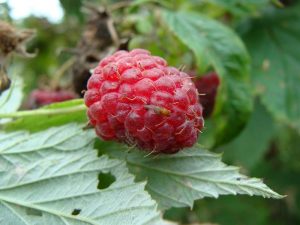
We continue to capture spotted wing drosophila fruit flies at our trapping sites in Southern Maine (see table below) and wild blueberry fields in the coastal and midstate regions. Drosophila larvae have been reported in raspberries, blueberries and cherries. Populations are over the recommended spray threshold (4/ trap/week) at many sites, but have not seen a significant increase over the past week, most likely due to the hot, dry conditions and early control sprays applied by growers.
If you are growing raspberries, blackberries and/or blueberries, you should be starting management practices now for spotted wing drosophila on any fruit that is ripening to prevent infestation. At most sites, a seven day spray schedule should be adequate to keep the fruit clean at this time. As populations increase, spray intervals should be tightened to five days to adequately prevent infestations.
For more information on identifying spotted wing drosophila (SWD) and updates on populations around the state, visit our SWD blog.
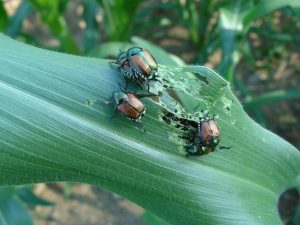
Japanese beetles are infesting many raspberry and blueberry plantings this season. There have been higher numbers of this pest this season feeding on foliage and fruit, and annoying pickers. There are several insecticides that are effective against Japanese beetles, but close attention should be paid to the re-entry and days-to-harvest intervals when applying them near or during harvest. Altacor® and Assail® both have one day to harvest, while Actara® has a three day interval and Sevin® has a seven day interval. Organic options include Aza-Direct® and PyGanic®, both with zero days to harvest. All of these products work best when applied at the first indication of beetles being present in the field. Netting is also available that has a fine enough mesh to keep beetles out (as well as birds), but it must be applied before the beetles arrive in the planting.
Other IPM Web Pages
Michigan State University Spotted Wing Drosophila
Penn State University Spotted Wing Drosophila Overview
University of New Hampshire SWD Weekly IPM Reports
David T. Handley
Vegetable and Small Fruit Specialist
Highmoor Farm
P.O. Box 179
Monmouth, ME 04259
207.933.2100
UMaine Extension Diagnostic Research Lab
Pest Management Unit
17 Godfrey Drive
Orono, ME 04473
1.800.287.0279
| Town | SWD weekly trap catch 6/27/25 | SWD weekly trap catch 7/11/25 | SWD weekly trap catch 7/18/25 | SWD weekly trap catch 7/25/25 |
|---|---|---|---|---|
| Wells | 0 | 4 | 9 | 3 |
| Springvale | 46 | 6 | ||
| New Gloucester | 0 | 14 | 42 | 37 |
| Cape Elizabeth | 0 | 56 | 101 | 16 |
| Bowdoinham | 0 | 8 | 43 | 45 |
| Mechanic Falls | 1 | 11 | 1 | 0 |
| Monmouth | 0 | 1 | 3 | 2 |
Where brand names or company names are used it is for the reader’s information. No endorsement is implied nor is any discrimination intended against other products with similar ingredients. Always consult product labels for rates, application instructions and safety precautions. Users of these products assume all associated risks.
The University of Maine System is an equal opportunity institution committed to nondiscrimination.