
Bulletin #2112, It’s a Sneeze, It’s a Wheeze, It’s … Gapeworms!

By Anne Lichtenwalner, DVM Ph.D., University of Maine Cooperative Extension
Reviewed and updated by Dana Hill, DVM, MS, Ph.D., DACVP, University of Maine Cooperative Extension
For information about UMaine Extension programs and resources, visit extension.umaine.edu.
Find more of our publications and books at extension.umaine.edu/publications/.
Syngamus tracheae, or the “gapeworm,” is one of several worms that can live in your chicken’s respiratory tract. This worm lives in the trachea, and causes coughing, wheezing and open-mouth breathing (“gapes”).
Birds get infected by eating the worm eggs from the feces-contaminated ground, or by eating earthworms, snails, slugs, and/or flies infected by the gapeworm larvae. In either case, the gapeworms mature and migrate within the chicken, ending up in the respiratory tract. They live in the trachea, laying eggs, which are coughed up by the chicken, swallowed, and passed out in the feces. Either another bird or an earthworm eats the eggs; then the cycle starts again.
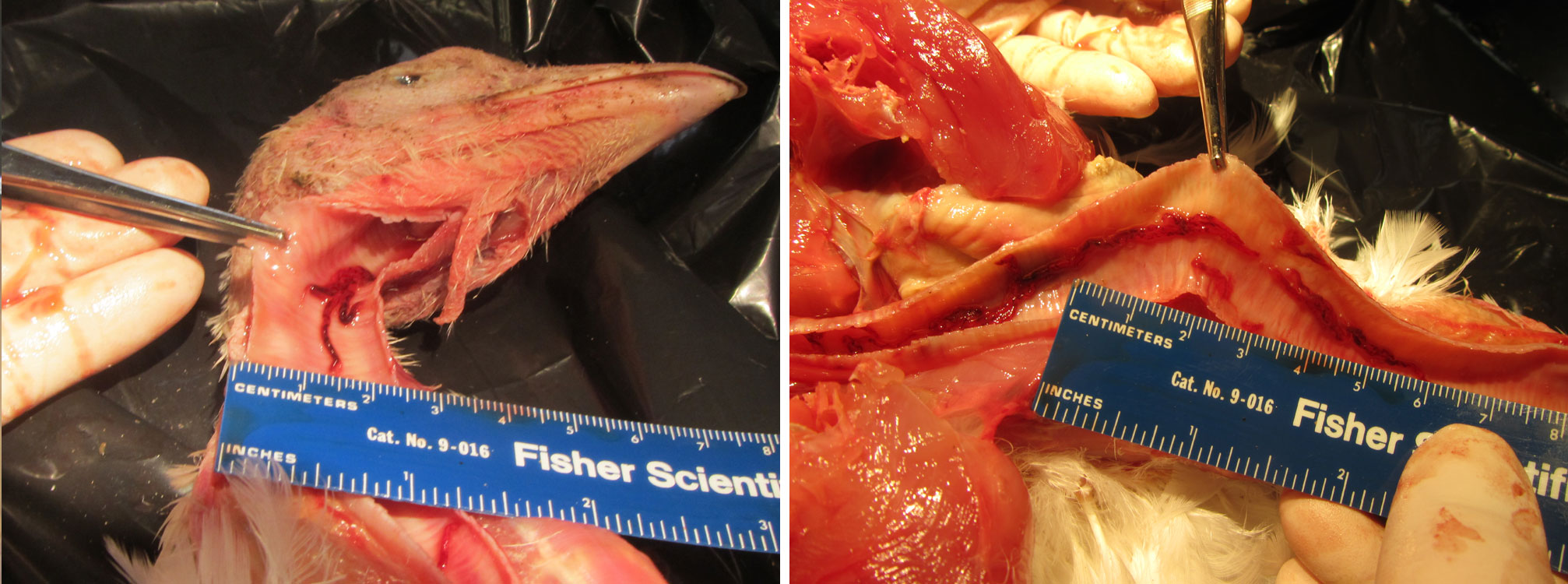
How can you tell if it is gapeworms are present? A fecal examination at the vet’s office may do it, or you can send a fecal sample to the University of Maine Cooperative Extension Veterinary Diagnostic Laboratory Lab for analysis. Alternatively, you could try parting the neck feathers, using a flashlight in a darkened room to transilluminate the trachea and try to visualize these bright red, 1/2-inch to 2-inch long worms through the thin skin of the hen (see the photo of a turkey trachea containing gapeworms below).
Similar respiratory symptoms may also be caused by bacteria or viruses, therefore, an examination by your veterinarian is the best course of action. Proper treatment is also provided with the help of your vet. Remember, not all dewormers kill all types of worms. Proper diagnosis will help you find the right product to use. Remember that using medications of any kind in livestock raised for food must be done exactly according to label directions, or following your veterinarian’s instructions.
How can you prevent gapeworm? In short, prevent exposures to wild birds and limit access to dirt:
- Consider keeping hens in “biosecure” coops and henyards that keep wild birds out by use of netting and overhead covers.
- Using a sand or concrete layer in the henyard can minimize the risk of infection by either contact with contaminated soil or with earthworms, snails, slugs, or flies.
- Many interesting coop designs are available on the internet. If you want to use a chicken “tractor” to allow your chickens access to pasture, please be sure to move it frequently enough that they are never on the bare or muddy ground.
Information in this publication is provided purely for educational purposes. No responsibility is assumed for any problems associated with the use of products or services mentioned. No endorsement of products or companies is intended, nor is criticism of unnamed products or companies implied.
© 2013, 2024
Call 800.287.0274 (in Maine), or 207.581.3188, for information on publications and program offerings from University of Maine Cooperative Extension, or visit extension.umaine.edu.
University of Maine Cooperative Extension is an equal opportunity institution and provider committed to nondiscrimination. For more information, visit extension.umaine.edu/nondiscrimination.