
4-H Tick Project
Overview | Instructions for Participants | Sampling Site Map | In the News| Registration
The 4-H Tick Project is a community science project engaging K-12 youth and educators, made possible through a partnership between 4-H Youth Development, UMaine Cooperative Extension Tick Lab, Maine Forest Tick Survey, and members of the Learning Ecosystems Northeast partnership. The project provides youth an opportunity to explore ticks and tick-borne diseases, which is a connected story of climate, ecosystem change, and public health.

All K-12 educators interested in teaching about ticks in Maine are encouraged to participate in the project at no cost to you. If you are a formal classroom teacher, after-school educator, 4-H volunteer, outreach coordinator at a local organization, librarian, science center staff, or any other educator working with youth ages 5-18, this project is for you!
The way the project works:
Educators conduct tick drags with youth participants to collect tick specimens in their local area. Specimens are returned to Hancock County 4-H, and then submitted to the UMaine Diagnostic Research Laboratory Tick Lab for identification and disease testing, which contributes to the lab’s Tick Surveillance program. Youth data also contribute to a community science (aka “citizen science”) project called the Maine Forest Tick Survey, which is a multiyear, multidisciplinary research project established to determine how forest land management practices impact tick populations and disease risk across Maine. Educators receive all test results from their sampling to use in activities with their youth. Project participants gain access to activity guides and lesson plans for facilitating engaging experiences with youth to learn about ticks in Maine.
Through the 4-H Tick Project, youth are engaged in real-world science and data exploration, and are contributing to important tick research efforts in Maine!
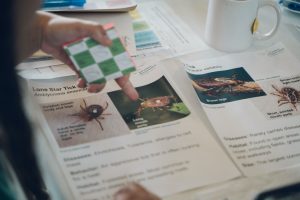
What we provide:
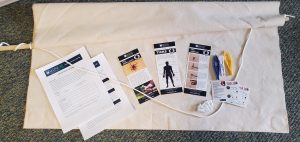
- Tick Collection Supplies (tick drag, collection vials, data sheets, tweezers, safety checklists)
- Instructional video and written protocol for how to conduct a tick drag
- Identification and disease testing services through the UMaine Diagnostic Research Laboratory Tick Lab
- Tick spoons and ID cards
- Educational resources to facilitate engaging experiences with youth to learn about ticks in Maine
- Phone, email, virtual and/or in-person support as needed
*Materials will be available for pickup at your local County Extension Office unless other arrangements are
made.*
Participant Responsibilities and Expectations:
- Commit to sampling at least once in a single location in their local area with a group of youth (ideally it would be multiple locations over time – for example, sampling two different areas such as a woods trail and a grassy playground during spring, summer, and/or fall)
- Follow all data collection protocols for tick dragging and sample collection (instructions are provided)
- Ship or drop off samples to the designated location (Hancock County Extension Office in Ellsworth, other arrangements can be made)
- Provide feedback and share your experiences with the project
- Report participant data such as the number of youth reached, etc.
In the News
- We Don’t Want Them to Be Afraid
- That Kid Found a Tick!
- Students Capture, Identify, and Study Ticks in Maine
- 4-H Collaboration Uses Ticks to Teach Kids About Ecosystems and Public Health
- Kids in Maine are Learning Skills to Identify Ticks and Tickborne Diseases
Interested?
If you are interested in participating in the 4-H Tick Project, please complete the form below and we will contact you to arrange the delivery of supplies. This is an ongoing project. Materials are available until supplies last.
4-H Tick Project
For more information or a reasonable accommodation, please contact Gabby Brodek, 4-H Youth Development Professional, at gabrielle.brodek@maine.edu or Emily Booth, 4-H Science Professional, at emily.booth@maine.edu.
This material is based upon work supported by the National Aeronautics and Space Administration under Cooperative Agreement No. NNX16AB94A issued through the Science Activation program at Science Mission Directorate.
The University of Maine System (the System) is an equal opportunity institution committed to fostering a nondiscriminatory environment and complying with all applicable nondiscrimination laws. Consistent with State and Federal law, the System does not discriminate on the basis of race, color, religion, sex, sexual orientation, transgender status, gender, gender identity or expression, ethnicity, national origin, citizenship status, familial status, ancestry, age, disability (physical or mental), genetic information, pregnancy, or veteran or military status in any aspect of its education, programs and activities, and employment. The System provides reasonable accommodations to qualified individuals with disabilities upon request. If you believe you have experienced discrimination or harassment, you are encouraged to contact the System Office of Equal Opportunity and Title IX Services at 5713 Chadbourne Hall, Room 412, Orono, ME 04469-5713, by calling 207.581.1226, or via TTY at 711 (Maine Relay System). For more information about Title IX or to file a complaint, please contact the UMS Title IX Coordinator at www.maine.edu/title-ix/.