
Maine Home Garden News – December
In This Issue:
- December Is the Month to . . .
- Winter Connections
- A Heartfelt Thank You to Our Newsletter Team
- Flowering in the North Conference
- Backyard Bird of the Month: Redpoll
- What’s in the House? Oh, Christmas Tree
- Maine Weather and Climate Overview
December Is the Month to . . .
By Kate Garland, Horticulture Professional
Learn more about Community Supported Agriculture (CSA) shares and consider purchasing them as gifts for friends and family this holiday season. CSA models come in a variety of forms ranging from a bulk credit to weekly boxes and everything in between. CSAs are a great investment in your future food supply!
Find a licensed arborist before you urgently need them. If you have trees on your property, it’s a good idea to know who to go to if something looks potentially unsafe. Ask neighbors, friends, or local gardening groups as word-of-mouth recommendations are often the best way to find reliable professionals. Hearing about others’ positive experiences can help you choose someone with confidence.

Get yourself a hand lens or magnifying glass and take a closer look at the world around you. I’m always amazed by how much more I notice when I slow down and focus on a single detail in the landscape. The curiosity it sparks is a reminder of how much there is to learn, and noticing small things can even make you a more successful gardener. Check out this guided observational activity and other nature journaling resources from Wild Wonder for great year-round ideas!
Winter sow native plants at your holiday party. If you’re looking for a fun new activity to add to your seasonal gathering, this might be a big hit for your friends and family – especially if they like getting their hands dirty! The process is simple, (see article: Sowing Native Seeds in Containers), supplies aren’t very costly, newly sown pots are easy to care for at home (i.e tuck them in a protected spot outside for the winter), and it’s a great way to get more people excited about native plants. What’s not to love?
Make some gifts from the kitchen with the help of our Expanded Food and Nutrition Program friends. Here are two blog posts that will surely inspire:
Winter Connections
Article and photo by Kate Garland, Horticulture Professional
As we move into the colder, quieter months in Maine, many of us feel the natural pull toward opportunities to gather, share and support one another. That spirit of community is at the heart of our work here in Extension and one of the most meaningful places we see it come to life is in our gleaning* efforts. This story from Rogers Farm** is just one example of the many gleaning projects happening across the state through our Maine Harvest for Hunger program, each strengthening community and increasing food access in its own way.
Having a demonstration garden on a research farm means that neighboring research plots often have crops ready for gleaning once data collection is complete. Over the past few years, dry beans have been one of the featured research crops for our gleaning program. Hundreds of pounds of shelf-stable dry beans have not only helped feed our neighbors, but have also brought people together in memorable ways.
Our first year, we simply pulled dry bean pods off plants in the field to thresh at a later time. My office was crowded with stacks of banana boxes filled with bean pods that we gradually shelled as the winter months passed. We brewed coffee, sampled snacks and enjoyed the hum of multiple conversations and laughs shared between a small team of volunteers who were enjoying the very satisfying process of hand-threshing dry beans. Yes, we probably could have found more efficient ways of processing the beans, but we all agreed that it was a treat to get out of the house on a cold winter day and sit around a table working together on a shared project for good. [1]
In the years since, we’ve shifted to mechanical threshing, but we’ve preserved the most important part: gathering to sort and bag the beans with cooking instructions from our Expanded Food and Nutrition Education Program (EFNEP) colleagues. The task has changed, but the companionship remains the same. This fall, when SNAP funds were at risk, volunteers generously donated dozens of canned goods, boxes of cornbread and biscuit mix and loads of spices to accompany the beans we were distributing.
This story is a reminder that connection can be cultivated, even during the times of year that feel most isolating. Join a garden club, connect with a gleaning group (yes, some are active in winter!), reach out to a food security organization, or call your local Extension office, United Way chapter, or library and simply ask, “How can I help?” There are countless ways to serve, share, and stay rooted in community. We all need purpose and it’s an honor for us in Extension to provide space where those connections can grow.
And to you, our newsletter readers and members of Maine’s vibrant gardening community, we extend our sincere appreciation. Your curiosity, generosity, and engagement are what make this work not only possible, but meaningful. You are the reason these connections flourish season after season. Thank you for being part of this community! We are excited to incorporate your ideas in the next round of newsletters. Share your feedback and ideas anytime.
Sending wishes for good health and cheer over the holiday season.
* According to the USDA, “Gleaning is simply the act of collecting excess fresh foods from farms, gardens, farmers markets, grocers, restaurants, state/county fairs, or any other sources in order to provide it to those in need.” We’re deeply grateful to the researchers and farmers who welcome gleaners into their fields, to our EFNEP colleagues for their partnership, and to our incredible volunteers whose dedication fuels this work.
https://www.usda.gov/sites/default/files/documents/usda_gleaning_toolkit.pdf
** Rogers Farm is part of the Maine Agricultural and Forest Experiment Station at the state’s R1 public research university.
A Heartfelt Thank You to Our Newsletter Team
Many thanks to the following team of editors, contributors and staff for their tremendous support!

Abby Zelz, Allan Amioka, Barbara Harrity, Carrick Gambell, Christina Lannan, Clarisa Diaz, Clara Ross, Debbie Schulz, Doug Hitchcox, Gary Fish, Hannah Mullally, Jenna Walters, Jennifer Cappello-Ruggiero, Jonathan Foster, Jude Hsiang, Kate McCarty, Lourdes Maria Engel, Lynne Holland, Maine Audubon, Maine Department of Agriculture, Conservation and Forestry, Matt Thomas, Melissa Kim, Michelle Snowden, Nancy Donovan, Naomi Jacobs, Nick Lund, Nita Stromann, Pamela Hargest, Patti Elwell, Phoebe Call, Rebecca Long, Rita Buddemeyer, Sean Birkel, Stacia Brezinski, Susan Joakim, Tammy Libby, Victoria Munsey, and Wendy Robertson.
We’ll be taking January off from the newsletter to develop the lineup for the coming year. Remember, there’s an extensive collection of articles in our archives for you to enjoy as you plan your horticultural adventures for 2026. Many of the topics suggested in the feedback survey are covered in the gems you’ll find in our archives.
If you value the work we do and are in a position to contribute, we’d be grateful for your support. A tax-deductible donation to our horticulture fund helps us continue offering educational programs to growers of all ages throughout Maine. Every gift, no matter the size, truly matters!
Flowering in the North Conference: registration is open!
The Flowering in the North (FITN) Conference is a first-of-its-kind event designed to support and strengthen cold-climate floriculture and specialty cut-flower production across Maine and the broader Northeast. Bringing together farmers, researchers, educators, and industry partners, FITN focuses on the unique challenges and opportunities of growing ornamental crops in northern climates, including season extension, protected culture, varieties that thrive in short growing seasons, and emerging production strategies. Through hands-on workshops, technical presentations, peer learning, and networking, the conference provides practical, research-based knowledge that supports growers at every scale—from new entrants to experienced producers—while fostering community, innovation, and long-term industry resilience. Learn more and register today!
Backyard Bird of the Month: Redpoll
By Maine Audubon Field Naturalist Stacia Brezinski

You may see large numbers of uncommon visitors at your feeder this winter. Poor seed crops in the boreal forest this year are forcing arctic and subarctic breeders southward. This type of species movement is called an “irruption.” Among irruptive species this year are Redpolls, small, bouncy finches that travel in large flocks. Their rosy-red caps and yellow bills help them stand out from other streaky brown seed-eaters. Males also sport rosy chests. They can be distinguished from House Finches by their smaller size and the black around their bill, which extends onto the chin (similar to the black face patch on a Northern Cardinal).
Redpolls are largely granivorous and prefer small seeds. Find them in conifers, willows, alders, shrubs, and on the ground foraging in grasses and small weedy plants. It might be easiest to spot them in birches, which are widespread and often grow at the edges of open areas. Watch as they pluck several papery seeds at a time. Many of these seeds will be stored in their esophagus to regurgitate and husk later in a more protected area. At the feeder, they’ll eat nyjer and black oil sunflower seeds.
You may have heard of several species of Redpolls, but recent DNA analysis suggests that they are one species with three subspecies. Common Redpolls are the most likely subspecies to be seen in Maine, but frosty-looking Hoary Redpolls may be mixed into flocks. Listen for a chatty group of birds, making sounds ranging from rattly trills to nasally “che” notes which evoke the chatter of House Sparrows.
This year’s “Winter Finch Forecast” predicts large numbers of Redpolls coming down from Eastern Canada. Other species expected to move into Maine are Red and White-winged Crossbills, Pine and Evening Grosbeaks, Pine Siskins, Purple Finches, and Red-breasted Nuthatches (which have been seen in abundance since August).
What’s in the House? Oh, Christmas Tree
By Jude Hsiang, retired Extension Master Gardener instructor and member of the China Community Garden. Originally published in The Town Line community newspaper and reprinted with the author’s permission.
When the family gathers for the holidays, we often look through the photo albums and reminisce. Look at pictures of your Christmas trees over the years. Decorated with ornaments, lights, and garlands, and surrounded by gifts, children and pets, the tree itself is hardly visible, but we remember its fragrance, as well as the happy faces around it.
In recent decades, our Christmas trees are generally farmed and groomed to become full green cones. But If you look at photos from the 1950s and earlier, the difference is striking. The branches back then were more widely spaced, and the needles were pretty sparse compared to the tree you may be looking for this holiday season. Those trees from years gone by looked like the firs we see in the woods. Some folks still go out to the woodlot to find a tree, but many of us will buy one from a nearby Christmas tree farm, which may also sell wreaths, garlands, and more. Santa might be there to greet you.
As a 14-year-old, a friend won a 4-H award for his chickens – a handful of balsam tree seedlings. Seventy years later, he, his son, and staff grow seven species of Christmas trees in addition to balsam firs – the traditional favorite of New Englanders – on 20 acres. Years ago it wasn’t unusual for some people to get their start in the Christmas tree business by digging or even pulling little fir seedlings in the woods in early spring to transplant on a north-facing slope. In seven years, the little trees would reach saleable height. (The same length of time it takes a lobster to reach your plate.)
Most Christmas tree farmers purchase 2- to 4-year-old seedlings from other farms and nurseries where trees are started from seed, transplanted as babies to the field, and finally sold in bundles to be grown to full size. As they grow the trees are carefully pruned to shape each year. There has been some resistance to “perfect” Christmas trees in recent years, as some customers prefer a more natural look. Whatever species, size and shape you want, the annual search for the right tree is a tradition.
Many growers belong to their regional Christmas tree farm association and also rely on their Cooperative Extension Service to keep up to date on trends in the market, and information on any threats to the crop from diseases, pests, and weather. The farmers may have a choose-and-cut operation, raise trees to be trucked to city markets, or a combination.
The Maine Christmas Tree Association has some useful tips for the customers, too. Like most plants, a Christmas tree is more than half water, and you’ll want to keep it fresh as long as possible in the warm, dry house after it’s become used to the cold during the fall. It’s best to have a stand that will hold about a quart of water for every inch of diameter of the trunk of the tree. Make a fresh ½ inch cut before putting it in the stand and check each day to be sure there’s still a good amount of water. Don’t trim off the bark or drill holes in the base. That won’t help the tree take up water, and it will damage the outer layers next to bark that do the work of moving water through the tree.
There’s more to think about such as keeping the tree away from heat sources and checking that lights are not going to add heat. It’s amazing to think that people used to regularly put lit candles on Christmas trees! Safety conscious folks turn off the lights before bedtime or if they are going out during the day.
Christmas tree growers remind us that natural trees are better for the environment. Among other benefits, real trees can be recycled. Once the holidays are over you can use the tree as mulch or start a wood pile that will shelter birds and small critters from the cold. Many towns now use the trees in various ways and encourage your help by offering streetside collection or designating drop-off spots.
If you have friends with goats, ask them if they’d like your used tree. – as long as it hasn’t been sprayed with any paint, artificial snow, or other inedible treatment. Goats love a post-Christmas snack!
Maine Weather and Climate Overview
By Sean Birkel, Assistant Extension Professor, Maine State Climatologist, Climate Change Institute, Cooperative Extension University of Maine
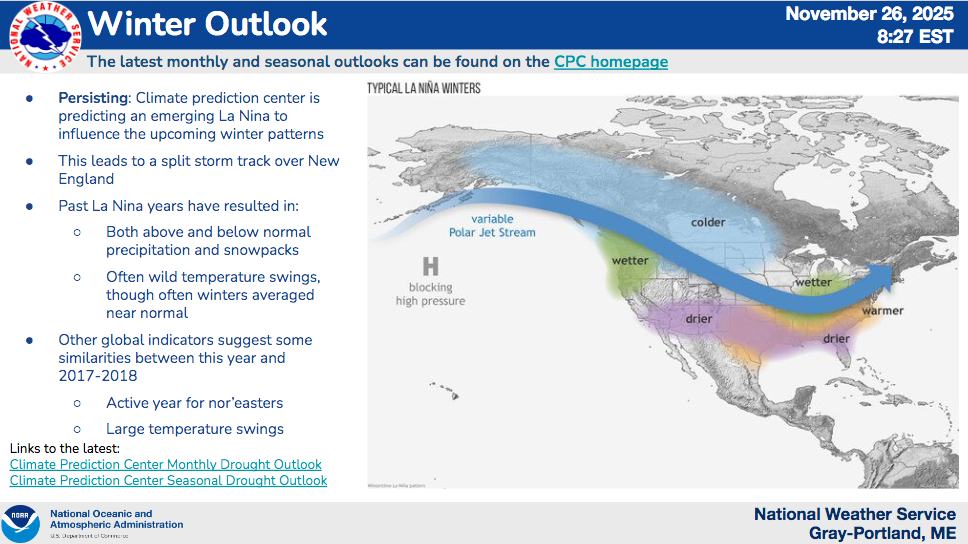
Observational data from Portland, Bangor, and Caribou show that November 2025 monthly mean temperature was near the long-term average at all three sites. Precipitation was below normal at Portland and Bangor (bottom 1/3) and near-normal at Caribou. Hydrologic drought continues across Maine with significant groundwater and streamflow deficits. The U.S. drought monitor classifies most of the state in either moderate (D1; 34% by area) of severe (D2; 63%) drought, but the Midcoast remains in extreme (D3; 3%) drought. There is some potential for improvement if sufficient rainfall develops before the ground freezes in the coming weeks. The amount of snow accumulation this winter and spring snowmelt and groundwater recharge in the spring will determine whether we will see a long-term drought signal. A summary of the latest National Weather Service drought briefing is available on the Maine Climate Office website.
The latest 6–10 and 8–14 day outlooks from the NOAA Climate Prediction Center show below normal temperature and above normal precipitation for the first half of December. Likewise, the latest U.S. and European global forecast model runs show seasonably cold temperatures and an active weather pattern producing snowfall in these next two weeks – winter is here! As always, your local forecast can be found at weather.gov.

Recent Maine Statewide 2025 Temperature & Precipitation Rankings
- Sep–Oct: 7th warmest (top 1/10), 39th driest (bottom 1/3)
- October: 12th warmest (top 1/10), 57th driest (near normal)
- September: 17th warmest (top 1/3), 27th driest (bottom 1/3)
Additional climate and weather data and information is available on the Maine Climate Office website.
Do you appreciate the work we are doing?
Consider making a contribution to the Maine Master Gardener Development Fund. Your dollars will support and expand Master Gardener Volunteer community outreach across Maine.
Your feedback is important to us!
We appreciate your feedback and ideas for future Maine Home Garden News topics. We look forward to sharing new information and inspiration in future issues.
Subscribe to Maine Home Garden News
Let us know if you would like to be notified when new issues are posted. To receive e-mail notifications, click on the Subscribe button below.
University of Maine Cooperative Extension’s Maine Home Garden News is designed to equip home gardeners with practical, timely information.
For more information or questions, contact Kate Garland at katherine.garland@maine.edu or 1.800.287.1485 (in Maine).
Visit our Archives to see past issues.
Maine Home Garden News was created in response to a continued increase in requests for information on gardening and includes timely and seasonal tips, as well as research-based articles on all aspects of gardening. Articles are written by UMaine Extension specialists, educators, and horticulture professionals, as well as Master Gardener Volunteers from around Maine. The following staff and volunteer team take great care editing content, designing the web and email platforms, maintaining email lists, and getting hard copies mailed to those who don’t have access to the internet: Abby Zelz*, Annika Schmidt*, Barbara Harrity*, Kate Garland, Mary Michaud, Michelle Snowden, Naomi Jacobs*, Phoebe Call*, and Wendy Robertson.
*Master Gardener Volunteers
Information in this publication is provided purely for educational purposes. No responsibility is assumed for any problems associated with the use of products or services mentioned. No endorsement of products or companies is intended, nor is criticism of unnamed products or companies implied.
© 2023
Call 800.287.0274 (in Maine), or 207.581.3188, for information on publications and program offerings from University of Maine Cooperative Extension, or visit extension.umaine.edu.