
Garlic IPM Newsletter No. 4 — May 8, 2025
Disease Forecasting
Cool, wet weather this week has slowed down GDD accumulations for insect pests and instead favored the development of fungal diseases. Three major fungal pathogens of garlic are combined into one onion diseases tool on NEWA, which is helpful because controls for all three are similar. This issue will break down how to use the platform for this purpose:
1. Determine whether the disease is present. Using these models is not a substitute for scouting. Familiarize yourself with their signs and symptoms. Refer back to the Week 1 newsletter for scouting instructions.
- Botrytis Leaf Blight/Blast (Botrytis squamosa)
- small, oval, water-soaked halo lesions first appear on young healthy foliage
- pale yellow to bleached necrotic spots then appear on older leaves
- See University of Wisconsin Vegetable Pathology for more information and image of disease
- Purple Blotch (Alternaria porri)
- distinctive elongated bulls-eye lesions start with yellow centers that turn purple to brown
- typically starts on older leaves
- similar to Stemphylium in appearance and management
- See UMass Extension for more information and images of disease
- Onion Downy Mildew (Peronospora destructor)
- irregular lesions progress from pale green, to yellow, to brown
- when lesions coalesce, leaves collapse
- gray-violet spores appear on infected leaves in high moisture conditions
- See University of Wisconsin Vegetable Pathology for more information and images of disease
2. Use the “Results Table” in NEWA to determine whether conditions favor infection. Each disease is favored by a specific set of environmental conditions. When those thresholds are met or exceeded, values are in red, as shown in the screenshot below. On the website, there is a “More Info” button below this table that offers an in-depth overview of how to use these data. The following steps offer a quick guide for interpretation.
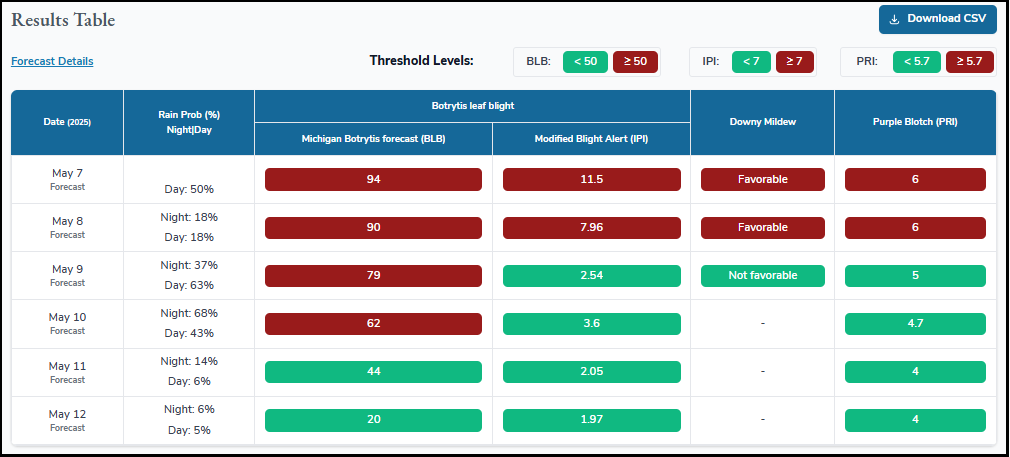
3. Botrytis leaf blight. NEWA uses two models to forecast botrytis leaf blight. The Michigan model is a good early season indicator to begin scouting. The action threshold for the first fungicide application is when a) there is at least one lesion per leaf on average, b) the Modified IPI > 7, and c) the chance of rain is 30% or greater. When both BLB indicators are over threshold, as for May 7 and 8 above, disease pressure is greater.
4. Onion downy mildew. When “favorable” conditions for this disease development are occasionally met, be especially perceptive for it while scouting. When 5 out of 7 days in a given timeframe are favorable, and especially where the disease is present or known to be problematic, maintain excellent protective fungicide coverage (see the New England Vegetable Management Guide for materials). Use the “Seven Day Summary” table above the results for past favorability ratings.
5. Purple blotch. This model is under development. When the disease is present, alliums at bulbing stages are typically most susceptible to infection – that is now for garlic in southern Maine, to several weeks out for those further north. Fungicide applications made for BLB and DM may provide coverage for this pathogen as well.
| Location | Botrytis Leaf Blight | Onion Downy Mildew | Purple Blotch |
|---|---|---|---|
| Augusta | begin scouting | scout / spray if known problem | scout |
| Bangor | begin scouting | scout | scout |
| Durham (NH) | begin scouting | scout / spray if known problem | scout |
| Lewiston | begin scouting | scout / spray if known problem | scout |
| Milton (NH) | spray for May 10 if lesion threshold met | scout / spray if known problem | scout |
| Rochester (NH) | begin scouting | scout | scout |
| Shelburne (NH) | begin scouting | scout / spray if known problem | scout |
- Fungicide guidelines: Apply protective fungicides in advance of favorable conditions when the disease is present; assume 7 days protection unless > 1″ rain (then reapply); do not exceed 10 day spray interval; be sure to rotate FRAC codes; see this Cornell fungicide “cheat sheet” for material guidance (ensure materials are registered for garlic in ME)
- Cultural controls: Use a 3-4 year allium crop rotation; remove and destroy all culls; encourage air flow with adequate plant spacing where possible and orient rows in direction of prevailing wind; avoid overhead irrigation
- Scouting update: No major insect pests or disease problems have been seen at any scouting location this week

Peyton Ginakes, PhD
Research Associate
University of Maine Cooperative Extension
Highmoor Farm
52 US-202
Monmouth, ME 04259
(207) 933-2100
This project is funded by a Specialty Crop Block Grant through the Maine Department of Agriculture, Conservation, and Forestry. Funding for the Maine 2024 Specialty Crop Block Grant Program was made possible by a grant/cooperative agreement from the USDA Agricultural Marketing Service. Its contents are solely the responsibility of the authors and do not necessarily represent the official views of the USDA.
Where brand names or company names are used, it is for the reader’s information. No endorsement is implied nor is any discrimination intended against other products with similar ingredients. Always consult product labels for rates, application instructions and safety precautions. Users of these products assume all associated risks.
The University of Maine System is an equal opportunity institution committed to nondiscrimination.