
Spotted Wing Drosophila Alert — October 3, 2025
Last Issue of the 2025 Season
David Handley, Vegetable and Small Fruit Specialist; James Dill, Pest Management Specialist; Phil Fanning, Assistant Professor of Agricultural Entomology; Christina Howard, Maine New Farmers Project Manager
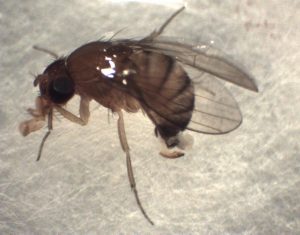
We have retired all of the trapping locations for our spotted wing drosophila monitoring program over the past two weeks. The numbers reported in the table below are the trap catch totals for the past two weeks, as we were not able to collect data the previous week. Fruit fly trap counts remained fairly moderate and stable for this late in the season, when we usually see numbers increasing. Now that colder temperatures are setting in, activity is expected to slow down, but flies can remain active even after the first few fall frosts. Should we see any tropical weather activity move in from the south in the coming weeks, drosophila activity could increase significantly and suddenly. Growers with late raspberries and day neutral strawberries should continue to monitor their plantings closely for flies and regularly check fruit for larvae. A 7-day spray schedule on ripening fruit may be required to keep it in good, marketable condition.
Spotted wing drosophila overwinter as adults (flies). It is thought that most of them do not overwinter in fruit plantings but migrate to wooded areas. Therefore, we do not recommend “clean up” sprays in fruit plantings for the flies once harvest is over. The overwintering flies can become active anytime the temperatures rise over 50 degrees, and may feed on flower nectar, decaying vegetation or any early fruiting plants in the spring, but it appears that only a small percentage of the flies actually survive throughout the winter (~20%). This is why it usually takes until late in the season here in Maine for the populations to build up to damaging numbers, unless more flies are brought in from southern locations on south to north moving storm fronts.
For more information on identifying spotted wing drosophila (SWD) and updates on populations around the state, visit our SWD blog.
Vegetable & Berry Growers Twilight Meeting: Friday, October 3, 5:00 p.m. at Bell Farm in Auburn, ME.
Other IPM Web Pages
Michigan State University Spotted Wing Drosophila
Penn State University Spotted Wing Drosophila Overview
University of New Hampshire SWD Weekly IPM Reports
David T. Handley
Vegetable and Small Fruit Specialist
Highmoor Farm
P.O. Box 179
Monmouth, ME 04259
207.933.2100
UMaine Extension Diagnostic Research Lab
Pest Management Unit
17 Godfrey Drive
Orono, ME 04473
1.800.287.0279
| Town | SWD weekly trap catch 8/15/25 | SWD weekly trap catch 8/22/25 | SWD weekly trap catch 8/29/25 | SWD weekly trap catch 9/5/25 | SWD weekly trap catch 9/12/25 | SWD weekly trap catch 10/3/25* |
|---|---|---|---|---|---|---|
| Wells | 135 | 323 | 468 | 341 | 222 | 535 |
| New Gloucester | 190 | 57 | 128 | 69 | 141 | 68 |
| Cape Elizabeth | 474 | 388 | 695 | 798 | 293 | 444 |
| Bowdoinham | 27 | 103 | 139 | 141 | 60 | 271 |
| Mechanic Falls | 86 | 115 | 220 | 71 | 71 | 58 |
| Monmouth | 40 | 24 | 30 | 13 | 11 | 124 |
*Numbers indicate two weeks of trap capture; all other columns represent one week.
Where brand names or company names are used it is for the reader’s information. No endorsement is implied nor is any discrimination intended against other products with similar ingredients. Always consult product labels for rates, application instructions and safety precautions. Users of these products assume all associated risks.
The University of Maine System is an equal opportunity institution committed to nondiscrimination.