
2025 Research Report – Dumpling Squash Evaluations
Peyton Ginakes, University of Maine Cooperative Extension Research Associate
David Handley, University of Maine Cooperative Extension Small Fruit & Vegetable Specialist
Mark Hutton, University of Maine Cooperative Extension Vegetable Specialist
A dumpling squash trial was initiated in 2025 at the University of Maine’s Highmoor Farm. The purpose of the evaluations was to evaluate the productivity and quality of ten dumpling squash cultivars. Cucurbita pepo winter squash breeding has progressed over the last several years to include shapes, skin colors, and flesh qualities that fall across the acorn to dumpling spectrum rather than distinctly within either category. The ten cultivars included in this study were chosen to compare type standards and new varieties in this broadening category.
Field Trial Methods
Squash were seeded into 50-cell trays filled with ProMix BX + Mycorrhizae media on May 30, and transplanted by hand on Jun 27 (one month after seeding). Plants were grown on raised beds covered with biodegradable black plastic mulch with 22” between plants. Each plot contained six plants, and the trial included five replications. Plants were fertigated by hand approximately weekly throughout the growing season using 1 Tbsp/gal of Jack’s Professional 12-45-10 Plant Starter soluble fertilizer.
Fruit were harvested on Sep 17, 82 days after transplanting. The number and weight of each fruit was recorded for each plant, and fruit that were visibly undersized were deemed culls.
Squash Quality Assessments
After yield data were collected, two sets of five fruit for each cultivar were set aside for later quality evaluations. The first set was cured for 5.5 weeks and then subjected to measurements, while the second set was cured for 9.5 weeks before evaluation.
Fruit quality was assessed using two quantitative methods – dry matter and soluble solids content – as well as a blind tasting. Dry matter was measured by boring three cores from fruit, collecting fresh weights, and drying samples at 140 °F until a stable weight was achieved. Soluble solids, a measurement of sweetness, was determined by boring three cores, and then freezing, thawing, and pressing samples to measure °Brix of sap on a handheld refractometer. Samples for the blind tasting were prepared by roasting slices of fruit. Evaluators ranked the appearance, texture, and flavor of each sample on a scale of 1 (poor) to 5 (excellent).
Results
Transplanting coincided with a heat wave at the start of a season-long drought, so overall yields were low and do not reflect optimal production. Still, clear trends and differences between cultivars were detected and future years’ research are expected to reveal which cultivars perform consistently.
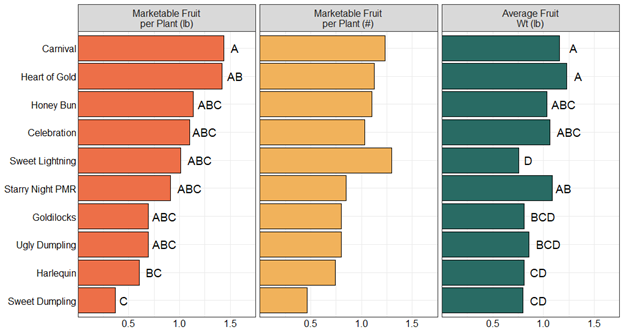
Cultivars produced yields ranging from 0.4 to 1.4 lb marketable fruit per plant (Fig. 1). Carnival and Heart of Gold produced significantly greater yield by weight than Sweet Dumpling, and Carnival additionally outyielded Harlequin. Plants produced 0.5 (Sweet Dumpling) to 1.3 (Sweet Lightning) fruit per plant, but there was no significant difference between cultivars. Carnival and Heart of Gold were the largest-fruited cultivars (1.2 lb), greater than Goldilocks, Harlequin, Sweet Dumpling, Sweet Lightning, and Ugly Dumpling (all less than 1 lb).
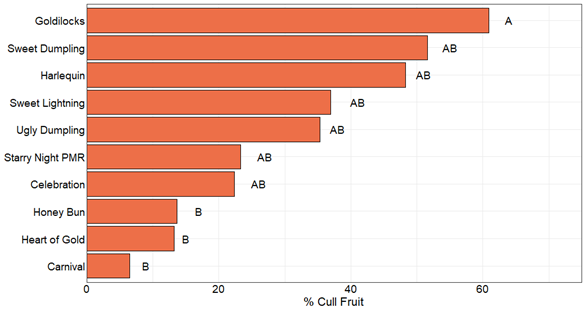
Goldilocks had a greater cull rate than Carnival, Heart of Gold, and Carnival (61% compared to less than 15%; Fig. 2). This was driven almost exclusively by undersized fruit and likely contributed to Goldilocks’ poor yield. Harlequin and Sweet Dumpling also had high cull rates and correspondingly low marketable yields.
No quality metric varied significantly by curing length, so data in Figures 3 and 4 are aggregated across both cure times. Dry matter did not vary significantly by cultivar but ranged from 9.1% (Goldilocks) to 13.9% (Starry Night PMR; Fig. 3). Greater dry matter is typically associated with better texture and eating quality. Similarly, Starry Night PMR had greater soluble solids than Goldilocks, as did Ugly Dumpling and Sweet Dumpling (> 13 °Brix compared to 7.1 °Brix).

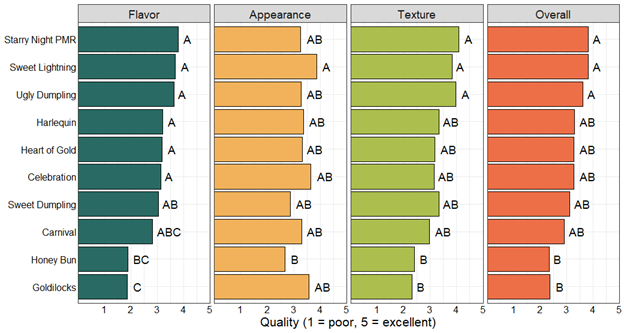
In a blind tasting, Starry Night PMR, Sweet Lightning, and Ugly Dumpling were all preferred over Honey Bun and Goldilocks overall (Fig. 4). This was closely linked to flavor and texture ratings, while ratings of appearance were more varied.
2025 Research Summary
Starry Night PMR, Sweet Lightning, and Ugly Dumpling had the best eating quality of the ten cultivars trialed and provide a choice between large and small fruit size preferences.
Carnival and Heart of Gold – both large-fruited varieties – were both top-yielding cultivars and had fair eating quality.
Goldilocks was relatively low yielding with high cull rates and poor eating quality.
Harsh growing conditions in 2025 severely impacted plant growth and more favorable weather in future trial years may improve yield and fruit quality. Still, those cultivars with fair yields and good quality in 2025 should be noted for their adaptability.
Cultivar Notes from 2025
| Carnival | |
|
|
|
| Celebration | |
|
|
|
| Goldilocks | |
|
|
| Harlequin | |
|
|
|
| Heart of Gold | |
|
|
|
| Honey Bun | |
|
|
|
| Starry Night PMR | |
|
|
|
| Sweet Dumpling | |
|
|
|
| Sweet Lightning | |
|
|
|
| Ugly Dumpling | |
|
|
|


Acknowledgements
This work was supported by the University of Maine Cooperative Extension, University of Maine Agricultural and Forestry Experiment Station, Maine Vegetable and Small Fruit Growers Association, New England Vegetable and Berry Growers Association, and Hatch ME022320. Gowan Seed Company, Harris Seeds, Johnny’s Selected Seeds, and Rupp Seeds generously donated materials for this project. We are grateful for assistance from Greg Koller, Patricia McManus, Claire Schaffer, Stephanie Wright, and Charlotte Trundy.
Please contact Peyton Ginakes at peyton.ginakes@maine.edu or (207)933-2100 with any questions or comments about this research.
© 2025
Download and Print:
Information on this website is provided purely for educational purposes. No responsibility is assumed for any problems associated with the use of products or services mentioned in this website. No endorsement of products or companies is intended, nor is criticism of unnamed products or companies implied.
The University of Maine System (the System) is an equal opportunity institution committed to fostering a nondiscriminatory environment and complying with all applicable nondiscrimination laws. Consistent with State and Federal law, the System does not discriminate on the basis of race, color, religion, sex, sexual orientation, transgender status, gender, gender identity or expression, ethnicity, national origin, citizenship status, familial status, ancestry, age, disability (physical or mental), genetic information, pregnancy, or veteran or military status in any aspect of its education, programs and activities, and employment. The System provides reasonable accommodations to qualified individuals with disabilities upon request. If you believe you have experienced discrimination or harassment, you are encouraged to contact the System Office of Equal Opportunity and Title IX Services at 5713 Chadbourne Hall, Room 412, Orono, ME 04469-5713, by calling 207.581.1226, or via TTY at 711 (Maine Relay System). For more information about Title IX or to file a complaint, please contact the UMS Title IX Coordinator at www.maine.edu/title-ix/.