
2025 Research Report — Garlic Evaluations
Peyton Ginakes, University of Maine Cooperative Extension Research Associate
David Handley, University of Maine Cooperative Extension Small Fruit & Vegetable Specialist
Mark Hutton, University of Maine Cooperative Extension Vegetable Specialist
Garlic is a high-value crop in the allium family that is propagated vegetatively from cloves. Garlic varieties fall into two categories: hardneck, which form false seed stems (scapes), and softneck, which do not. Hardneck varieties tend to be more cold hardy and therefore comprise the bulk of what is grown in Maine. The resulting crop can be used or sold as seed stock when it is of very high quality, or as table stock.
Eight commercially available hardneck garlic ecotypes were compared in 2025 at the University of Maine’s Highmoor Farm to evaluate their winter hardiness and marketable yields. Separately, three mulching systems (straw, black plastic, and straw + black plastic) were also compared for their effects on winter survival and plant growth.

Field Trial Methods
Beds were prepared by incorporating 50 lb. nitrogen (N) per acre of 10-10-10 fertilizer into the soil. On November 8, cloves were planted by hand into 4-row beds on an 8 inch between- and within-row spacing. They were planted 4 inches deep and covered with 4-6 inches of straw to prevent frost heaving. Each plot consisted of 20 plants, and plots were arranged in a randomized complete block design with four replications. Mulch trial plots were arranged in the same manner, using only the variety Music. Black plastic was laid by hand in appropriate plots and covered with straw accordingly. Straw was raked from straw + black plastic plots on April 16 into pathways between the plots.
Plants were sidedressed twice in spring: first on April 29, when they were approximately 8 inches tall, with 40 lb. N per acre of urea (45-0-0), and again one month later at a rate of 60 lb. N per acre, for a total nitrogen application of 150 lb. per acre.
Scapes were harvested in early July once they formed full curls, and mature bulbs were harvested on July 25 for all varieties except German Red, which was fully developed and harvested one week later. To harvest, a garden fork was used to assist in pulling plants. Soil adhering to bulbs was lightly shaken off, and tops were trimmed to six inches. They were then moved to a barn and spread in a single even layer on a mesh table. Doors were kept open while plants cured for two weeks.

Data Collection
Once tops and wrapper leaves were fully dry, tops were further trimmed to one inch and roots were trimmed as close to the basal plate as possible (Figure 2). Bulbs were categorized as being of marketable size (> 1.5” in diameter) or unmarketable (smaller). Some wireworm damage and split bulbs were noted, but were ultimately counted as marketable because there were no detectable variety differences. The weight of each bulb was recorded.
Variety Trial Results
Clear differences in winter survival were observed (Fig. 3). Only 60% of German Red cloves survived, less than all other varieties except Purple Russian. 100% of Premium Northern White survived the winter. German Extra Hardy and Music also had high survival rates over 95%.

German Extra Hardy and Purple Russian both had 100% marketable sized bulbs, significantly more than Chesnok Red and Duganski, which had 26% and 16% undersized bulbs, respectively (Fig. 4).
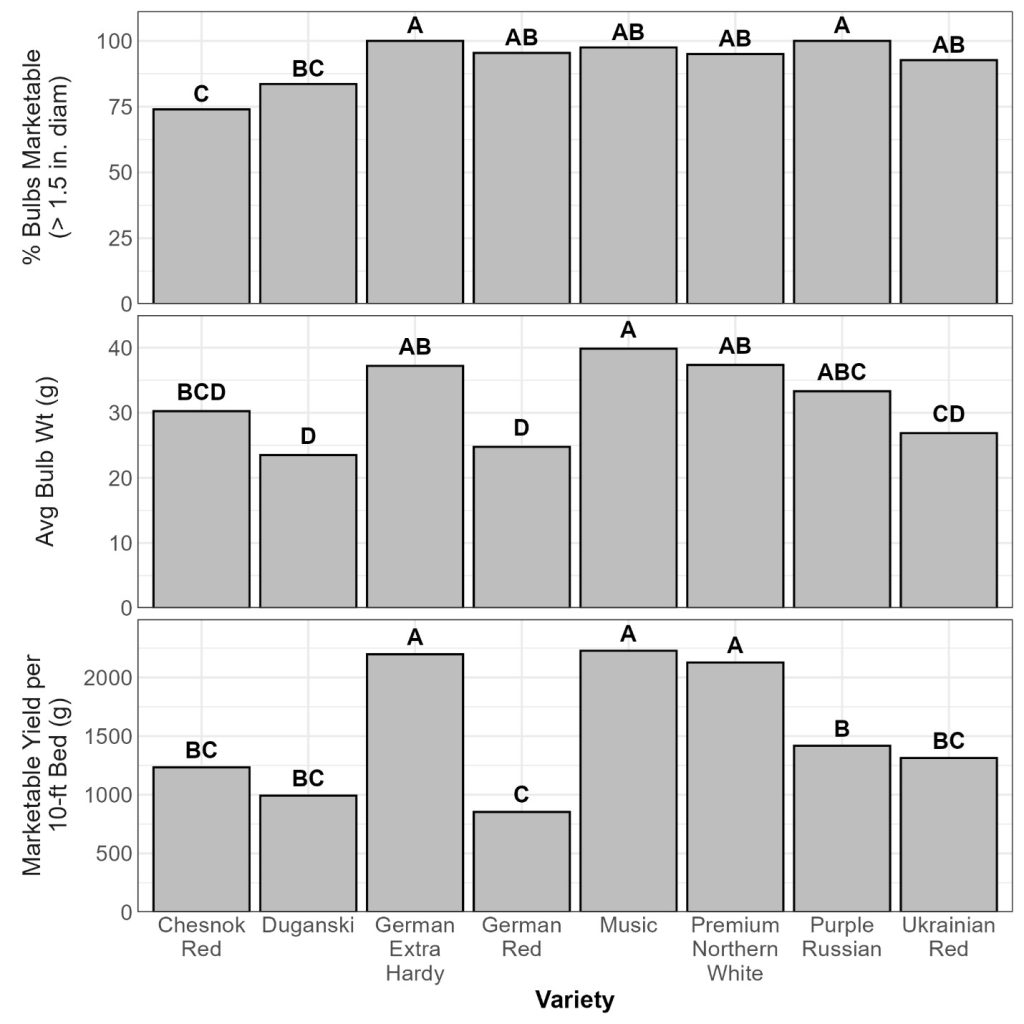
Music, German Extra Hardy, and Premium Northern White produced larger bulbs (35+ g) than Ukrainian Red, Duganski, and German Red (Fig. 4). Overall, bulb size was very small. This was likely the result of drought conditions that characterized this growing season; this trial was not irrigated and adequate soil moisture during bulb expansion is critical for attaining maximum size.
Music, German Extra Hardy, and Premium Northern White ultimately produced the greatest yield, owing to both their high winter survival and large bulb size; each produced more than 2000 g of marketable garlic per 10-ft bed (Fig. 4). This contrasts with the low-yielding Duganski and German Red, each of which produced less than 1000 g per 10-ft bed, due to low winter survival (German Red) and small bulbs.
This trial is being repeated for the 2026 season with the same cultivars to assess how consistently they perform.
Mulch Trial Results
Mulches were compared to illustrate the importance of insulating garlic cloves against freeze-thaw soil temperature fluctuations in winter, which can heave freshly planted cloves to the surface, often tearing some or all of the roots from the basal plate in the process (Fig. 5). However, during the spring and summer, black plastic warms soil much quicker and thus promotes plant growth. We hypothesized that by combining both mulches, garlic survival and yield would be greater than in either mulch alone.

As expected, winter survival of cloves planted into straw and straw plus black plastic was greater than those planted into only black plastic and left uncovered (76 and 95%, respectively, versus 44%; Fig. 6). While bulbs were slightly larger when grown on black plastic, the difference was not statistically significant and likely resulted from the larger amount of space per plant due to poor plant survival. Despite this, marketable yields of garlic planted into the straw plus black plastic treatment were nearly three times greater than black plastic alone due to much improved winter survival.

Acknowledgements
This work was funded by a Specialty Crop Block Grant through the Maine Department of Agriculture, Conservation, and Forestry. Funding for the Maine 2024 Specialty Crop Block Grant Program was made possible by a grant/cooperative agreement from the USDA Agricultural Marketing Service. Its contents are solely the responsibility of the authors and do not necessarily represent the official views of the USDA. Additional support was provided by the University of Maine Cooperative Extension, University of Maine Agricultural and Forestry Experiment Station, Maine Vegetable and Small Fruit Growers Association, New England Vegetable and Berry Growers Association, and Hatch ME022320. We are grateful for assistance from Greg Koller, Patricia McManus, Chris Howard, Marianne Renaud, Claire Schaffer, Stephanie Wright, and Charlotte Trundy.
Please contact Peyton Ginakes by email at peyton.ginakes@maine.edu or (207)933-2100 with any questions or comments about this research.
© 2025
University of Maine Cooperative Extension is an equal opportunity institution and provider committed to fostering a nondiscriminatory environment and complying with all applicable nondiscrimination laws. Consistent with State and Federal law, UMaine Extension does not discriminate on the basis of race, color, religion, sex, sexual orientation, transgender status, gender, gender identity or expression, ethnicity, national origin, citizenship status, familial status, ancestry, age, disability physical or mental, genetic information, veterans or military status, income derived from a public assistance program, political beliefs, reprisal or retaliation for prior civil rights activity, in employment, education, and all other programs and activities.
The University of Maine System provides reasonable accommodations to qualified individuals with disabilities upon request. Persons with disabilities who require alternative means of communication for program information (e.g., Braille, large print, audiotape, American Sign Language, etc.) should contact the UMaine ADA Coordinator or contact USDA through the Telecommunications Relay Service at 711 (voice and TTY). Additionally, program information may be made available in languages other than English.
If you believe you have experienced discrimination or harassment, you are encouraged to contact the System Office of Equal Opportunity and Title IX Services at 5713 Chadbourne Hall, Room 412, Orono, ME 04469-5713, by calling 207.581.1226, or via TTY at 711 (Maine Relay System). For more information about Title IX or to file a complaint, please contact the UMS Title IX Coordinator at www.maine.edu/title-ix. To file a program discrimination complaint, complete the USDA Program Discrimination Complaint Form, AD-3027, found online at www.usda.gov/oascr/how-to-file-a-program-discrimination-complaint and at any USDA office or write a letter addressed to USDA and provide in the letter all of the information requested in the form. To request a copy of the complaint form, call (866) 632-9992. Submit your completed form or letter to USDA by: (1) mail: U.S. Department of Agriculture, Office of the Assistant Secretary for Civil Rights, 1400 Independence Avenue, SW, Mail Stop 9410, Washington, D.C. 20250-9410; (2) fax: (202) 690-7442; or (3) email: program.intake@usda.gov.