
Sweet Corn IPM Newsletter No. 8 — August 14, 2026
Corn Earworm Populations Remain High
Silking Corn Requires Protection at All Sites
Situation
Dry conditions continue to dominate much of the state and keeping up with irrigation for thirsty plants has become a major chore for many farms. Corn harvest continues in full swing with quality and demand remaining high. A lack of uniformity in stand has led to some ups and downs in supply, but as later plantings mature this should improve.
European corn borer: Moth counts continue to be very low. Although we caught moths at more locations, none were over the threshold of five moths in the presence of silking corn. Larval feeding damage in pre-tassel corn remains low, and no sprays were recommended for corn that is not yet silking.
Corn earworm: Moth counts continue to be high in nearly all coastal and southern locations. All sites are on a recommended spray interval for fresh silking corn. A 6-day spray interval for silking corn was recommended in Farmington and Palmyra; A 5-day spray interval was recommended for Corinth and Oxford. A 4-day spray interval was recommended for Biddeford, Bowdoinham, Dayton, Gray, one Lewiston site, Monmouth, Wayne and Wells. A 3-day spray interval was recommended for Cape Elizabeth and one Lewiston site.
Fall armyworm: Moth numbers in pheromone traps were variable among trapping sites this week, exceeding the threshold of three per week in silking corn at Biddeford, Bowdoinham, Gray, Lewiston, Monmouth, Oxford and Palmyra. All of these locations are also on a spray schedule for corn earworm, which will control fall army worm. Fall armyworm larval feeding damage was generally light and not over the recommended spray threshold at any location.
Western Bean Cutworm: Moth and egg mass counts were variable this week but continue to decline overall. However, many sites had potentially damaging populations, and a protective silk spray would be recommended if these fields were not presently on a spray program for corn earworm. No larval feeding injury exceeded the spray threshold for pre-tassel corn.
Squash vine borer: Moth numbers in pheromone traps were lower overall this week, no sites exceeded the 5-moth threshold.
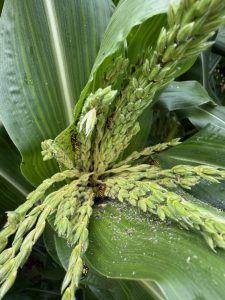
Corn leaf aphids are infesting tassels in nearly every field. Aphid colonies may expand to the ears and cause sooty mold. Products that offer control of aphids include Assail.
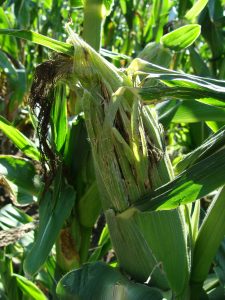
Birds, etc.: Flocking species of blackbirds are starting to cause damage in cornfields. They are especially attracted to fields where corn is over-mature. Deer have also been especially troublesome this year. For information on wildlife problems and management options, you may call the Animal and Plant Health Inspection Service (APHIS) office in Augusta at 1-866-487-3297.
Deep Compost School at Sound Pine Farm:
Join the University of Maine Cooperative Extension and Sound Pine Farm on August 25 for a field day about deep compost mulch soil management for vegetables. Participants will hear about our project, tour Sound Pine Farm’s deep compost mulch fields, and take part in a discussion with fellow farmers and Extension staff. This field day is free to attend, though registration is required. Visit the Deep Compost Mulch Field Day at Sound Pine Farm’s event page for registration and agenda.
Sincerely,
David T. Handley
UMaine Extension Vegetable & Small Fruit Specialist
Highmoor Farm
P.O. Box 179
52 U.S. Route 202
Monmouth, ME 04259
207.933.2100
UMaine Extension Diagnostic Research Lab
Pest Management Unit
17 Godfrey Drive
Orono, ME 04473
1.800.287.0279
| Location | CEW Moths | ECB Moths | FAW Moths | WBCW Moths | % Feeding Damage | Recommendations / Comments |
|---|---|---|---|---|---|---|
| Biddeford | 31 | 1 | 6 | 2 | – | 4-day spray interval recommended for silking corn |
| Bowdoinham | 33 | 0 | 14 | 10 | 10% | 4-day spray interval recommended for silking corn |
| Cape Elizabeth | 111 | 0 | 0 | 1 | 9% | 3-day spray interval recommended for silking corn |
| Corinth | 4 | 0 | 0 | – | 3% | 5-day spray interval recommended for silking corn |
| Dayton | 50 | 0 | 0 | 6 | 0% | 4-day spray interval recommended for silking corn |
| Farmington | 3 | 4 | 2 | 9 | – | 6-day spray interval recommended for silking corn |
| Gray | 91 | 0 | 8 | 34 | – | 4-day spray interval recommended for silking corn |
| Lewiston I | 120 | 0 | 37 | 18 | – | 3-day spray interval recommended for silking corn |
| Lewiston II | 35 | 3 | 5 | 1 | – | 4-day spray interval recommended for silking corn |
| Monmouth | 34 | 0 | 33 | 2 | 6% | 4-day spray interval recommended for silking corn |
| Oxford | 5 | 3 | 7 | 9 | 0% | 5-day spray interval recommended for silking corn |
| Palmyra | 2 | 0 | 4 | – | 1% | 6-day spray interval recommended for silking corn |
| Wayne | 14 | 1 | 1 | 10 | – | 4-day spray interval recommended for silking corn |
| Wells | 23 | 0 | 1 | 3 | 5% | 4-day spray interval recommended for silking corn |
| Wells II | 62 | 0 | 2 | 1 | 0% | 4-day spray interval recommended for silking corn |
CEW: Corn earworm (Only fresh silking corn should be sprayed for this insect.)
ECB: European corn borer
FAW: Fall armyworm
| Moths caught per week | Moths caught per night | Spray Interval |
|---|---|---|
| 0.0 to 1.4 | 0.0 to 0.2 | No spray |
| 1.5 to 3.5 | 0.3 to 0.5 | Spray every 6 days |
| 3.6 to 7.0 | 0.6 to 1.0 | Spray every 5 days |
| 7.1 to 91 | 1.1 to 13.0 | Spray every 4 days |
| More than 91 | More than 13 | Spray every 3 days |
Thresholds apply only to corn with exposed fresh silk. Lengthen spray intervals by one day if maximum daily temperature is less than 80°F.
European Corn Borer Thresholds
Whorl stage: 30% or more of plants scouted show injury.
Pre-tassel-silk: 15% or more of plants scouted show injury.
Silk: 5 or more moths caught in pheromone traps in one week.
IPM Web Pages:
Explore Integrated Pest Management in Maine — UMaine
Integrated Pest Management — UMass Amherst
Where brand names or company names are used, it is for the reader’s information. No endorsement is implied nor is any discrimination intended against other products with similar ingredients. Always consult product labels for rates, application instructions and safety precautions. Users of these products assume all associated risks.
University of Maine Cooperative Extension is an equal opportunity institution and provider committed to nondiscrimination. For more information, visit extension.umaine.edu/nondiscrimination.