
Strawberry IPM Newsletter No. 1 — May 15, 2026
2026 Strawberry Pest Management Season Begins
Save the Date: Vegetable and Berry Growers Twilight Meeting at Clark’s Farm, June 4, 5:30 p.m.
Situation
Spring has been slow to start and characterized by many cool, cloudy days. Although many parts of the state are still in a moderate drought, water levels have recovered somewhat since last summer, and the long-term forecast is calling for “normal” rainfall through the season. Strawberry plants are showing good initial growth in the fields visited this week. Some early varieties that were under rowcovers are starting to bloom in southern Maine, but mostly flower buds are just now visible in the crowns.
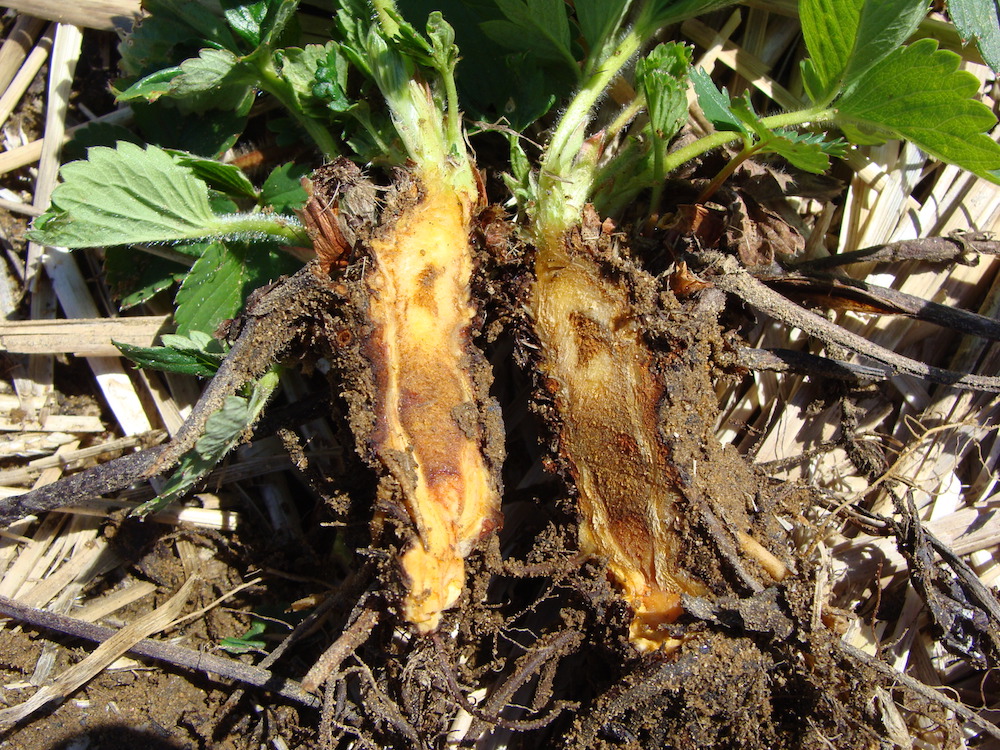
Winter Injury: Some moderate winter injury has been observed in areas where growth was weak last year, or the winter mulch was inadequate. Plants suffering winter injury may appear weak or dead: especially in more exposed parts of a field, where mulch was not applied or where mulch was displaced by wind or animals. This is caused by freezing of the tissue in the crown of the plants, and can be diagnosed by cutting into the crowns of the strawberry plants. The internal tissue will show dark brown discoloration. To reduce the impact of winter injury, make sure the plants get plenty of water as they start to grow and set fruit, and apply nutrients to encourage root growth and flower development. These should include: nitrogen, calcium, and phosphorus. However, heavy nitrogen (N) fertilizer applications are not recommended in the spring, but up to 20 pounds of actual N (e.g. 125 lb. calcium nitrate) may improve early growth.
Spring Weed Management: Herbicides available for spring applications in strawberries are very limited due to concerns about plant injury and harvest intervals. Devrinol® is registered for use in the spring and can be very effective on annual grasses and some broadleaf weeds, but only has pre-emergent activity, i.e. will not control weeds already emerged. There are other herbicide options for strawberries in the spring that have some post emergent activity but may only be applied with a shielded sprayer to the areas between the plant rows, not directly over the plants, or injury is likely to occur. These materials include Chateau®, Prowl H2O®, Satellite Hydrocap®, and Aim®.
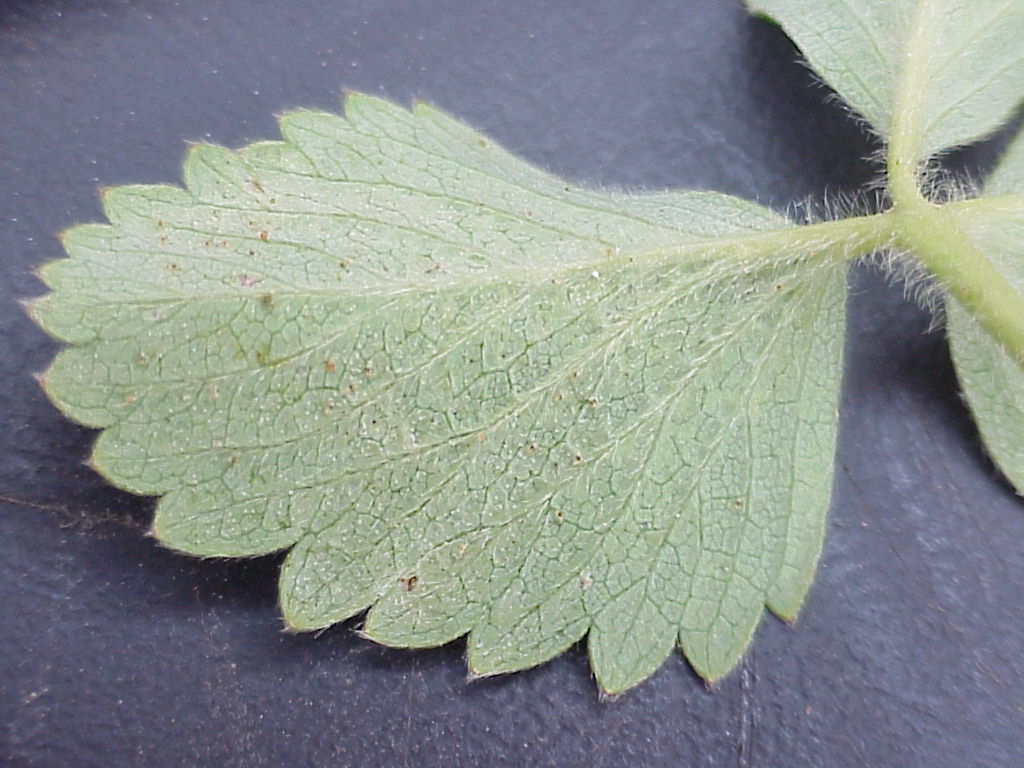
Two-spotted spider mites: One of the first problems often encountered on strawberries once the new foliage starts to emerge is spider mites. All of the fields scouted this week had mites, but only one field was over the recommended management threshold. Mites overwinter on the plants and will start to feed on the undersides of the leaves under warm, dry conditions. This can occur very early on plantings under rowcovers or in high tunnels. Scout for mites regularly once the plants begin to grow. Spider mites are mostly found on the undersides of strawberry leaves. Infested leaves will develop yellow flecking and a bronzed appearance, and the plants become weakened and stunted. Fields that have had excessive nitrogen fertilizer and/or row covers tend to be most susceptible to mite injury. To scout for mites, collect 60 leaves from various locations in the field and examine the undersides for the presence of mites. Mites are very small – you may need a hand lens to see them. Chemical control options for two-spotted spider mites include Acramite®, Portal®, Nealta® Savey®, Zeal®, Vendex®, Oberon®, Brigade®, Danitol® and JMS Stylet Oil® (oils will cause plant injury if used in combination with captan or within 14 days of an application of sulfur).
Cyclamen mites: We have seen symptoms of cyclamen mites in fields this spring. If your planting had indications of cyclamen mite damage last season, begin looking for injury as soon as new growth begins. Infested plants show weak growth and shrunken, crinkled leaves. These mites are very small and reside in the crown of the strawberry plant, feeding on the developing leaves and flower buds. They are very hard to see, even with magnification. Portal® miticide can be effective, but must be applied in lots of water to be sure that the material is carried down into the crowns where these mites reside.
Insects: We have not yet found any evidence of either strawberry bud weevil (clipper) or tarnished plant bug, but we expect them to become active once the temperatures rise and strawberry flowers begin to appear. Begin scouting for these pests once the flower clusters emerge from the plant crowns.
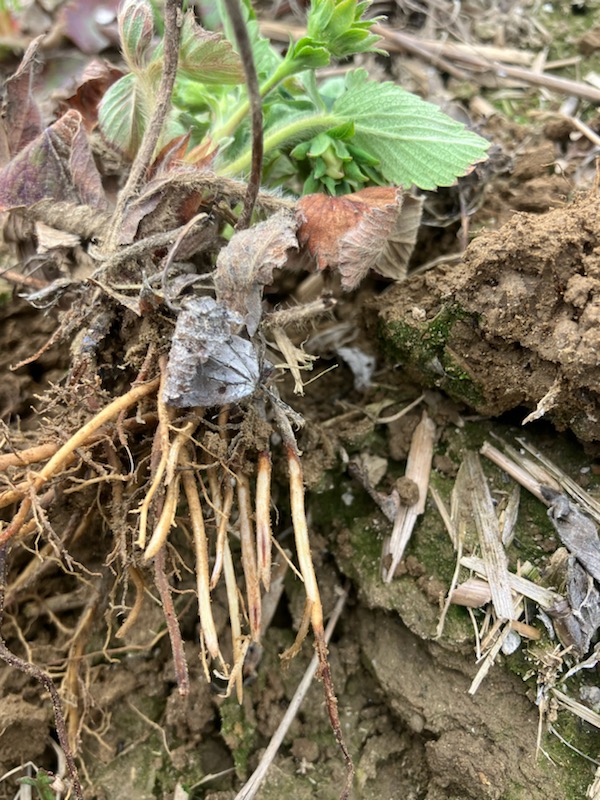
Red stele root rot: Sites that have been wet either last fall or this spring may be threatened by this root rot. Check for any spots in your fields that appear to be weak, stunted or dying. To diagnose red stele, pull up a few plants that look weak and scrape the roots of these plants to see if the center of the root, known as the stele, is rusty red in color, instead of the normal white. The red color would indicate an infection. Red stele is caused by Phytophthora fragariae, a soil pathogen that infects roots when soils are wet with temperatures around 50F. The pathogen grows into the roots causing the plants to become weak, stunted and to eventually die. Symptoms are most evident in the spring and can be mistaken for winter injury. Ridomil Gold®, Alliette® or Phostrol® are fungicides that can be applied in the early spring for control of red stele. In newly planted beds, RootShield® may be applied as a pre-plant root dip to help prevent infections. Many varieties have some level of resistance to the disease, but the most effective management strategy is to plant only into well-drained soils, and/or plant onto raised beds.
Gray Mold: This fruit rot gets started when overwintering spores of the fungus infect the newly opened flowers. Therefore, management efforts should be focused on the bloom period. Two to three sprays of fungicide during bloom are typically required to provide good protection. Fungicide choices for control of gray mold in strawberries include: Topsin M® + captan, Elevate®, Captevate®, Switch®, Scala® and Pristine®. Remember to alternate fungicides with different modes of action for resistance management purposes.
We have begun scouting strawberry fields for overwintering insect pests and disease issues. The results of our strawberry scouting will be reported through this newsletter until harvest time. You can also view these newsletters online with colored pictures through the UMaine Highmoor Farm’s newsletters page or the UMaine Pest Management web page. If you have questions about the Newsletter, please give us a call at 207.933.2100 or send an e-mail to: david.handley@maine.edu.
Spring Growers’ Twilight Meeting
The Maine Vegetable & Small Fruit Growers Association will be having a Spring Twilight Meeting on Thursday, June 4, at 5:30 pm at Clark’s Farm, 65 Boynton Schoolhouse Rd., Jefferson. The Farm boasts PYO strawberries and a wide variety of vegetables sold through their Farm Market.
New England Small Fruit Management Guide
A new edition of this guide is in the works and should be available soon. In the meantime, you can access the latest information through the online version. Visit the New England Small Fruit Management Guide for more detailed pest information.
The best way to manage strawberry pests is to scout your own fields regularly and often. You should begin to scout as soon as flower buds emerge from the crowns and continue to monitor the plantings one or two times per week up until harvest.
Sincerely,
David T. Handley
Vegetable & Small Fruit Specialist
Highmoor Farm
P.O. Box 179
Monmouth, ME 04259
207.933.2100
Pest Management
17 Godfrey Drive
Orono, ME 04473
1.800.287.0279
Where brand names or company names are used, it is for the reader’s information. No endorsement is implied nor is any discrimination intended against other products with similar ingredients. Always consult product labels for rates, application instructions and safety precautions. Users of these products assume all associated risks.
University of Maine Cooperative Extension is an equal opportunity institution and provider committed to nondiscrimination. For more information, visit extension.umaine.edu/nondiscrimination.