
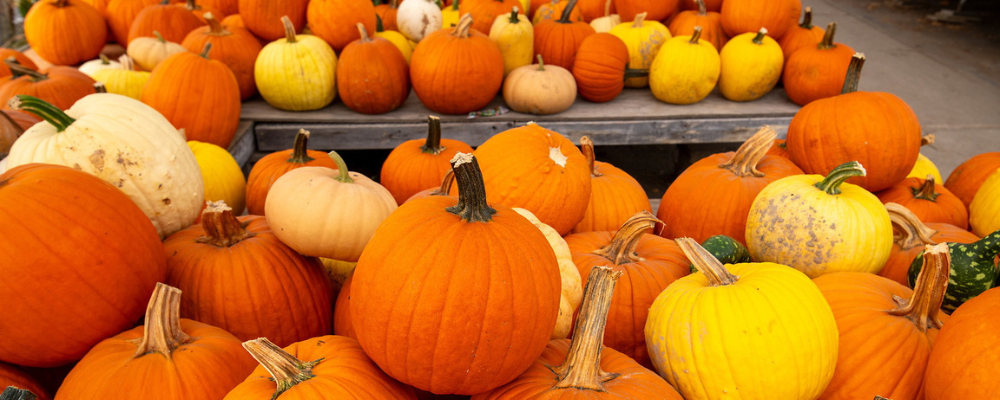
Pumpkins: More Than Just a Jack-O-Lantern
— By Kate Yerxa, MS, RD, Extension Professor, University of Maine Cooperative Extension
Pumpkins are a type of winter squash and are an excellent source of vitamin A, which is what gives them their deep yellow to deep orange color. Vitamin A is important for keeping your skin healthy, preventing eye problems, and promoting a strong immune system.
Pumpkins grown in Maine have a shorter season and are typically available in September and October. If you are thinking about growing pumpkins next year, University of Maine Cooperative Extension Bulletin #2190 lists varieties that can be successfully grown in Maine, including:
- Mini: Jack-Be-Little, Munchkin, Baby Boo (white), Wee-B-Little
- Small: Mystic Plus, Baby Pam, New England Pie, Neon, Baby Bear, Hybrid Pam
- Medium: Magic Lantern, Merlin, Rocket, Racer, Phantom
- Large: Howden, Sorcerer, Rock Star
- Giant: Prizewinner, Atlantic Giant
Selecting and Storing Pumpkins
When you’re choosing pumpkins, look for one that is brightly colored, firm, heavy, and free of blemishes. Avoid any pumpkins that have soft spots, cuts, breaks, or shriveled skin.
Pumpkins must be stored in a cool, dry place. If you choose to store them outside, make sure there is no danger of frost. For more tips on storing pumpkins, check out the following YouTube video: How To Harvest and Store Pumpkins.
Cooking Pumpkins
There are many ways to prepare pumpkins besides carving jack-o’-lanterns or roasting pumpkin seeds. Here are a few methods for cooking or preserving pumpkins to use in your favorite recipes. If you need ideas for ways to use pumpkin, check out the University of Maine Cooperative Extension’s Mainely Dish Recipes.
Steaming:
- Wash the pumpkin.
- Peel the pumpkin and cut it into two-inch cubes. Another option is to steam larger pieces with the rind left on. Once they are cooked, the rind can easily be removed.
- Bring one inch of water to a boil in a pan. Place either a colander or a collapsible steaming basket in the pan. Place the vegetables in the colander or steamer and cover it tightly. Reduce the heat to medium-low, and steam for 25-40 minutes, or until the pumpkin is fork-tender.
- The vegetables can either be served cubed or mashed.
Baking:
- Wash the pumpkin.
- If the pumpkin is smaller, just cut it in half. If it is large, cut it into individual portions to shorten the baking time.
- Scoop out all of the seeds and fibers.
- Bake the pumpkin at 400 degrees F for 1 to 1 ½ hours. One way to shorten this baking time is to bake the halves covered for the first 30 minutes. Then remove the cover for the rest of the baking time.
Microwaving:
- Wash the pumpkin.
- If the pumpkin is smaller, just cut it in half. If it is large, cut it into individual portions to shorten the baking time.
- Scoop out all of the seeds and fibers.
- Cover each of the halves with plastic wrap and place in the oven, leaving space between them. Microwave them on high power for 5 to 8 minutes per half. If you are working with a larger variety of winter squash, cut it into individual portions. Arrange the pieces in a microwave-safe dish and cover with plastic wrap. Cook for 3 to 4 ½ minutes per piece. After half of the cooking time has passed, rotate the dish so the winter squash cooks evenly.
- Let the squash stand, covered, for about 5 minutes.
Preserving Pumpkins
You can also preserve pumpkins by freezing or canning them. For instructions on freezing pumpkin, visit Bulletin #4384, Freezing Vegetables, and for instructions to can pumpkin, follow the instructions in Bulletin #4382, Canning Vegetables in a Pressure Canner.
Adapted with permission from: Bulletin #4176, Vegetables and Fruits for Health: Winter Squash and Pumpkins, University of Maine Cooperative Extension. 2008.